|
|
The county wouldn’t let us
drill under the road. We let Gary
go, and hired another soils engineer to attempt one more time to find an area
suitable for a septic field. The
engineer took one look and said, “We’ll try here”. The area was back from the street just
before the hill steepened. It
perced.
I asked him how he knew the drainage was good in that particular area,
and he pointed out the manzanita trees.
Manzanitas like well-drained soils.
The well driller came out and witched the bottom portion of the lot. He said, “We’ll put the well here,” and
pointed to a place near the bottom of the lot next to the creek. I asked him if he based his decision
solely on the use of witching. He
said, “Look around at the rocks. Do
you see the splits in the rocks?” I
did. He said, “If you line up all
of the cracks in the rocks, they all point to where we’re standing. The rocks crack along the lines of
fissures in the mountain. The
fissures are pointing in this direction, so this is where we’ll have the best
chance for water.”
The driller brought his rig in.
Everything was self-contained.
An arm lifted each pipe into position as the drill bit bore
downwards. When I stopped by to see
how it was going, a steady stream of water was coming out of the hole, along
with blue granite debris. Water was
struck at 70’, but it was contaminated with nitrates. At 300’, the flow of water was clean and
steady. Andy asked if we wanted to
keep going, and we continued drilling to 400’. The water was certified as potable by an
independent laboratory in El Cajon.
The well charged at a rate of 19 gpm, and our draw was calculated at 15
gpm. It was a good rate of
flow. The driller said that in the
lower lot, we could see rates up to 40 gpm if we ever decided to add a well to
the other parcel.
Because the bore went through granite, we did not need a well
casing.
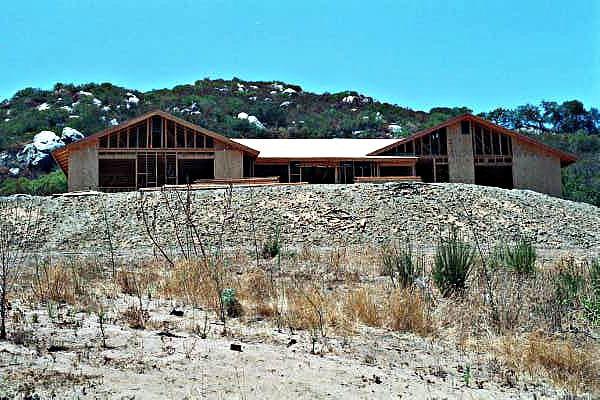
Construction went forward
without too many surprises. We
discovered that the chimney for the woodstove was inside the house, instead of
going through the exterior wall and up a chase. The chase became a wood storage
area.
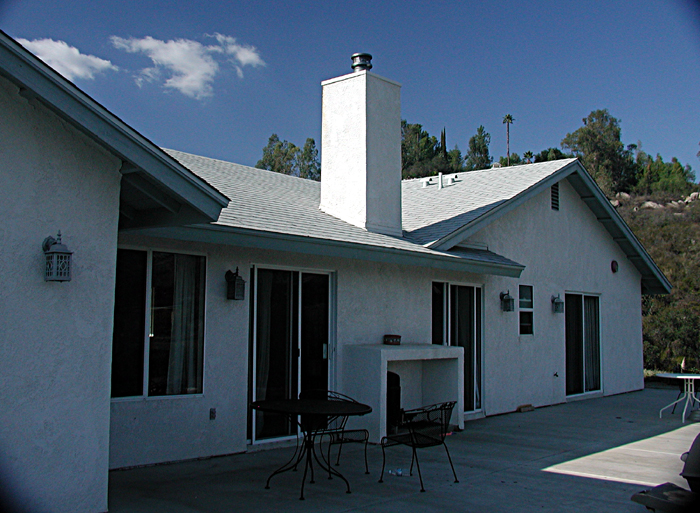
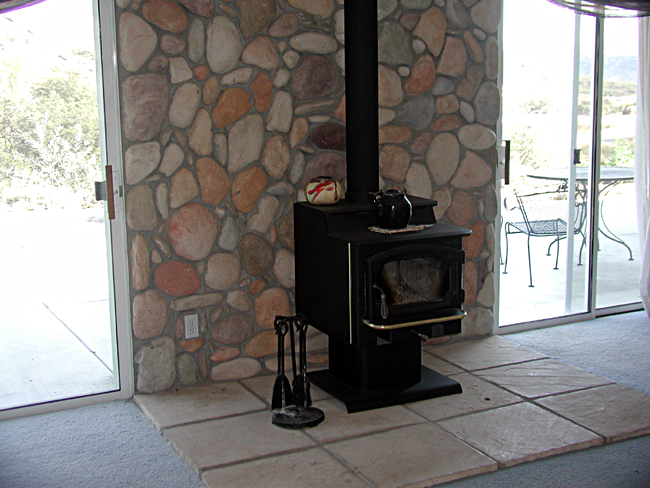
The sliding glass doors on each side of the woodstove and hearth were installed to open in the same direction. We had specified that the doors were to open in opposite directions away from the hearth. This was corrected.
We ran into two glitches with the county. Both times the county said we did not
have a correct permit. In each
case, Andy went above the counter clerk level to someone he knew in management,
and the problems were corrected. I
think if we had been on our own, we would have stalled out more than once in
county dealings.
We moved the month of
November, 1999, 2.5 years after we moved to Ramona. The house is
beautiful.
Some things that
worked:
I would not put in a fireplace, ever again. The wood stove not only provides us with heat in the wintertime, enough heat to keep most of the house warm, but it also allows viewing of the fire through the glass doors. The fire is of a different quality than a fireplace. The slow burning releases gasses, which ignite and roll across the top of the firebox. During the winter, we rarely turn on the furnace. By reloading the stove at bedtime and dampering the fire, the stove heats throughout the night. In the morning, if needed, the fire is still burning and can be restored by restocking. The cost of heating by wood is less than it would cost to heat with gas.
The major environmental design decisions were formed around the heat of
the summer. The house is white,
with a light roof to reflect sun and heat.
Most of the windows and glass doors face east and west, to minimize solar
gain from the south.
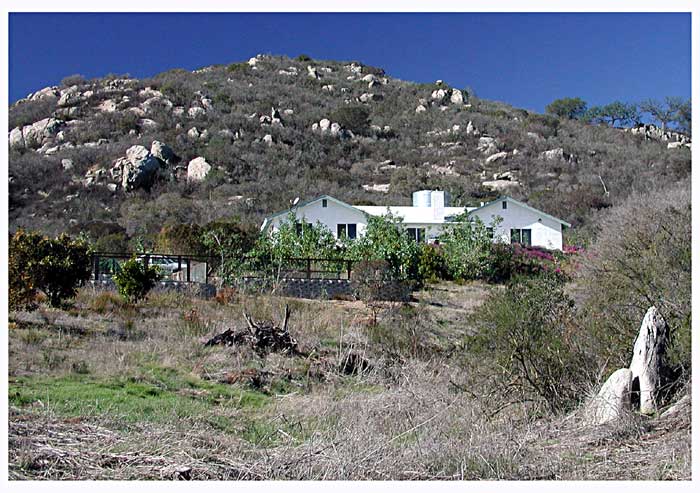
We sited the house on the east side of the mountain. Our house actually sits backwards on our lot, with most of the glass facing east. When the sun comes up in the morning, it warms the house. During the day, the ceiling fans moderate the heat. By 5:30 PM, the sun has moved behind the mountain, and we are in shade. Pools of cool air begin to flow down the mountain and to collect in the creeks. The temperature drop can be as much as 10 degrees when we walk from the house down the driveway to the road. Our house sits in the path of this flow. We still turn the air conditioning on during the heart of the summer for a few hours each afternoon, but for the most part, our energy costs are low.
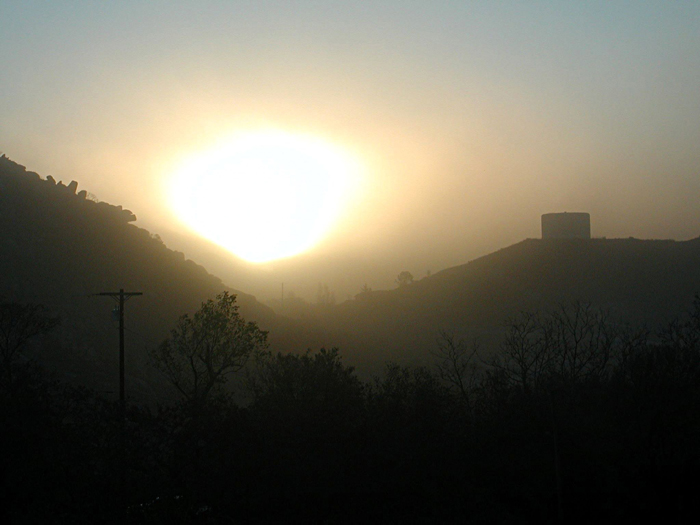
One fortunate accident in siting the house is that in the winter, the sun rises between a notch in the mountains. In the summer, the sun rises from behind a ridge, giving us extra minutes of protection from the heat.
We had extra money available towards the end of construction. This money went into the finish
concrete. The specified 3’ concrete
patio was extended out to 10’ on the east and south sides of the house, to take
advantage of the views.
Our garage really isn’t a garage.
It was built to expand the house into 4 bedrooms when we have extra time
and money. The floor was not
sloped, but rather was finished flat.
The garage door was never hung, and shortly after we moved in, we
installed sliding glass doors where the garage door was supposed to be. When the house is built out, it will
have approximately 2100 square feet.
A garage can be built separately somewhere else on the lot, if
needed.
Every time we thought about putting the land back on the market, giving
up, and buying in the nearby neighborhood, we would drive out and look at a
development. It kept us pushing
towards resolving our problems and finishing the house. We didn’t want to live in a
box.
We owe our realtor JC an enormous debt of gratitude. He went all out to make our project a
success.
From here looking back, it was worth the wait. We’ll probably do this again someday, now that we know what to expect and what to avoid.
|
|
|
|
|
|